Analog Friends 10: Chiara on Paper, Poem, and Seasonal Wonder
Hello, Analog Friends! This month, Hanny conversed with Chiara from Paper Poem—an artist behind a stamp studio based in Italy, well-known for her whimsical, soft, and magical illustrations.
In this series of Cafe Analog’s blog called ANALOG FRIENDS, we invite you to enjoy long-form reading at a slower pace (preferably with a cup of coffee, tea, or chocolate!)—while getting to know the people behind Cafe Analog’s products you love.
Enjoy!
Hello, Analog Friends! Hanny here! When we just took over Cafe Analog, during one Christmas break at Daniele’s town in Italy, we hand-delivered an order to a customer, Chiara, who lives in the neighbouring city. Since we were there with our families, we didn’t have that much time to talk or journal together in a cafe or anything (something I would definitely want to do when we meet again!).
But this was how I started getting to know Chiara—with her stamp studio/Etsy shop Paper Poem, where she sells her handmade stamps, seasonal boxes, tiny clay desk-mate, and some beautiful paper pieces. The name Paper Poem is best to describe her style! We’re so happy to announce our new collaboration with Chiara, including some stamps that will be available at the shop this May (and more to come in June!), and a surprise paper bundle exclusively made for Cafe Analog’s July 2025 Stationery Box!
Hanny: Hi, Chiara! How did you start your Paper Poem shop? Have you always enjoyed drawing?
Chiara: Hello Hanny, first of all, thank you for this opportunity — it’s truly a pleasure and an honor to share my little
world with you. Paper Poem was born out of both a need and a desire for connection. I’ve loved making notebooks and writing lists since I was a child, and about six years ago, I discovered the wonderful, magical world of journaling.
After a musical education, I enrolled at the Brera Academy of Fine Arts, where I studied for five years. Interestingly, I never really drew or painted during my studies — I specialized in creating light and sound installations, often working around the theme of air. That said, my time at the Academy was essential for the development of Paper Poem. It helped me refine a personal method of observing nature and the small details of life — elements I always try to incorporate into my work. From how objects or leaves shift in tone depending on the light throughout the day, to the impressions and layers one can perceive in a single place, to the idea of moving through air—this vast space that seems empty but is full of invisible, delicate phenomena.
Back then, I was still in high school, and I started creating and selling a few items so I could buy stationery — mainly stamps—designed by overseas illustrators I admired. At the same time, I began to create my own designs to use in
my journaling pages.
I’ve always loved drawing, though, as I mentioned, it’s a skill I developed alongside my academic path. I’m a very shy person, and probably, if I hadn’t started Paper Poem, I would have kept creating quietly in my corner, never meeting amazing people like you. Over time, balancing university and life, I gradually developed more and more ideas and designs, growing together with Paper Poem.
Hanny: Your designs are so dreamy and soft, so whimsical, making me want to run to the nearby forest! What infuses your creativity, and does it have some personal story behind it? Have you always loved this style of drawing/illustration?
Chiara: Nature is my main source of inspiration. Every detail—from color variations to lines and atmospheres—comes from or echoes something I’ve seen or experienced. I’m lucky to live on a hillside in a city with a large lake, surrounded by mountains. Since I was a child, walking through the woods has always meant finding something magical and unexpected: a chamois grazing in the grass, an especially intriguing pattern on tree bark, or a hidden white quartz crystal behind a rock. Flowers seemed like fairies accompanying me on the path, and the animals were shy friends to greet from afar. Even now, I still find myself amazed, as if time had never passed. These are moments of deep gratitude.
Yes, I’ve always loved this particular drawing and illustration style. I like rough and whimsical lines that remain simple at heart—embellished with a touch of mystery and a quiet, delicate balance that runs through them.
Hanny: Which artists inspire or influence you? What kind of “art” do you consume yourself? How do you think appreciating other artists’ works feeds into your creativity?
Chiara: There are many different kinds of artists who inspire me. A big part of that inspiration comes from illustrators and stationery designers who have had (and still have) a huge impact on me. Among them are names like Ivy Snow, Avocadomori, and Matka — the simplicity, and at times the imperfection, of their drawings has always influenced my work, as have the wonderful illustrations by Sanae Sugimoto or Tuyo.
On the other hand, as someone who has studied mostly contemporary art, artists like Christiane Löhr, Tomás Saraceno, and Daniel Steegmann Mangrané have been essential in shaping my perspective. I’m also deeply inspired by the beautiful botanical photographs of Anne Geene, especially those featured in her Book of Plants. Writers, too, are an endless source of inspiration for me: I love the poetry of Rainer Maria Rilke, as well as that of Mary Oliver and Emily Dickinson. In literature, I’m fascinated by the metaphorical language of Clarice Lispector, the imaginative structures in Italo Calvino’s books, and the dreamlike atmospheres described by Marcel Proust in In Search of Lost Time.
I feel that these different ways of making art are like many facets of the same gem, of the same idea. Often, when a line from a book or a poem resonates with me, that emotion generates something new — sometimes a drawing, sometimes a small creation in clay or ceramic, or even another poem. As I wrote, for me they are all simply shades of the same fascination.
I appreciate each form for different reasons, though I always try to create with a purpose —whether to enrich the soul or bring beauty to a workspace, for myself and for others. Drawing and working with clay help me give shape to my thoughts, to literally trace out a feeling. I love the tactile nature of materials, the scent of wood, the texture of clay in my hands. Since I make everything by hand, that physical, sensory process is a vital part of my day.
Books, however, are a love all their own. I believe that writing and reading have an unparalleled imaginative power — intensely personal and one-of-a-kind. They often help me abstract concepts and perceptions, turning emotion into form.
I truly believe that observing, reading, listening to the work of others, as well as to the world around us — and being moved by what we see helps us build a vast inner archive of forms we can draw from. Sometimes I’ll look at something I’ve made and realize that a line or a shape in it echoes something I once saw in a building years ago, which quietly became a part of me and evolved into something new.
Hanny: I have always thought Italy is an “artsy” country. You have a long history of great masters in paintings and sculptures, and a tradition in beautiful stationery like paper marbling, letter sets, leather book binding, glass pens, and many more! How do you see this in today’s era/generation? Do you think there’s still enthusiasm/appreciation for analog paper crafts in Italy?
Chiara: Yes, I believe that Italy’s artistic richness is both its greatest pride and, paradoxically, one of its limitations. In my opinion, we’ve become somewhat frozen in time—our timeless beauty locked away in museums—without truly finding a modern and practical way to integrate it into our everyday lives.
Take our relationship with paper, for instance. Its techniques are still mostly explored within the academic world or preserved by a few local artisans in big cities. But beyond those settings, it rarely feels alive, accessible, or meaningful.
Let me explain better: I don’t think the lack of enthusiasm is simply due to a disinterest in stationery itself, but rather to the absence of a narrative that connects it to our present needs and lifestyle. What’s missing, I feel, is a kind of storytelling that weaves these objects into the rhythms of daily life—a communication that sparks conscious fascination, showing the poetic, practical, and expressive possibilities that lie within them.
In recent years, I’ve noticed some multinational brands starting to introduce planners and travel journals into the Italian market, and I’ve felt some enthusiasm around it. But often, in this context, the handcrafted charm and refined aesthetic seem to be stripped away, replaced by a more standardized approach.
I believe we need a new kind of balance—a way to merge these emerging trends with a deeper awareness of our artistic heritage. That’s how we can rediscover beauty and creativity, even in the smallest gestures of everyday life.
Hanny: What do you think is your main challenge in running a shop while also working and making your own products? What is your dream for PaperPoem?
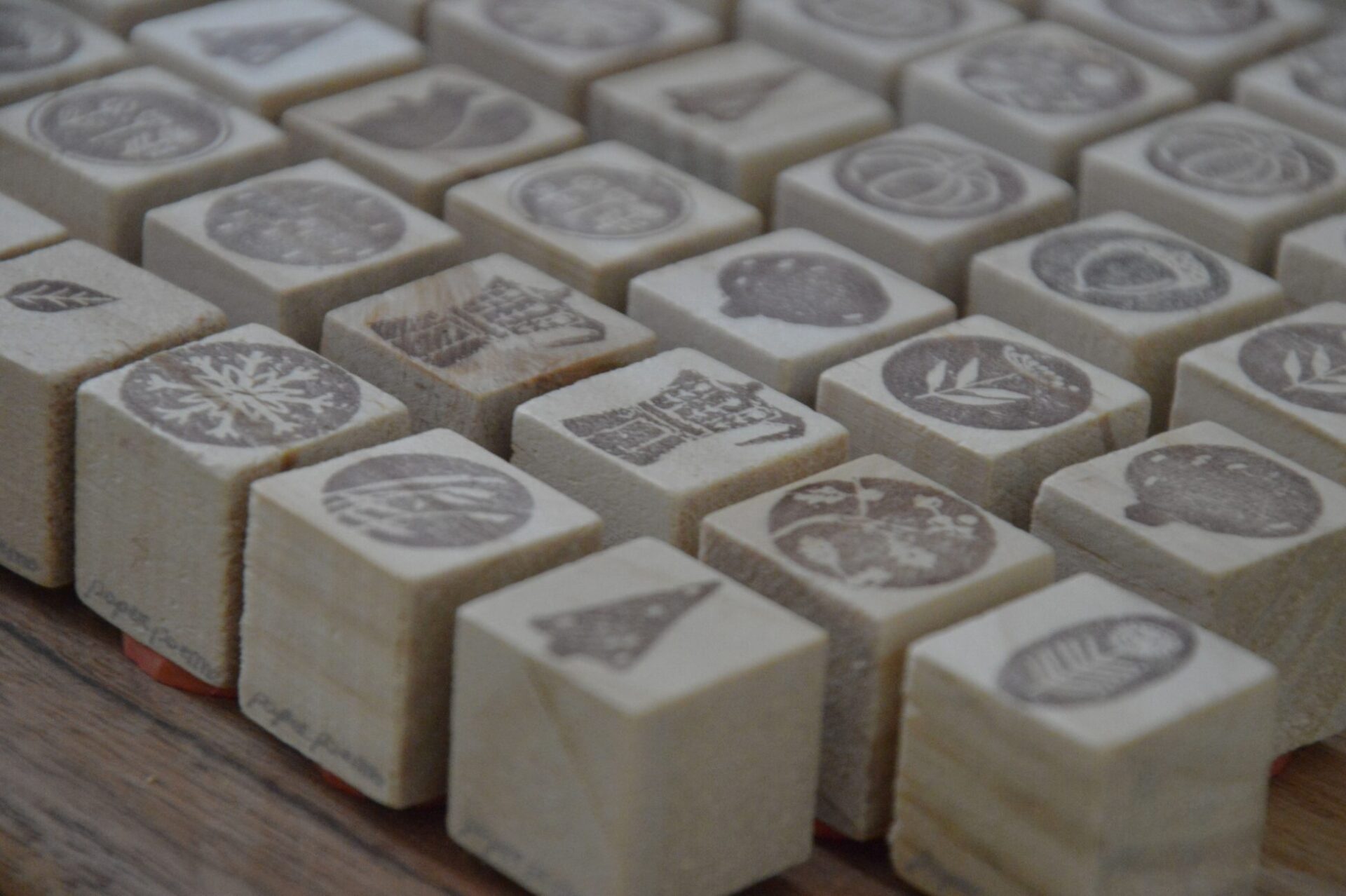
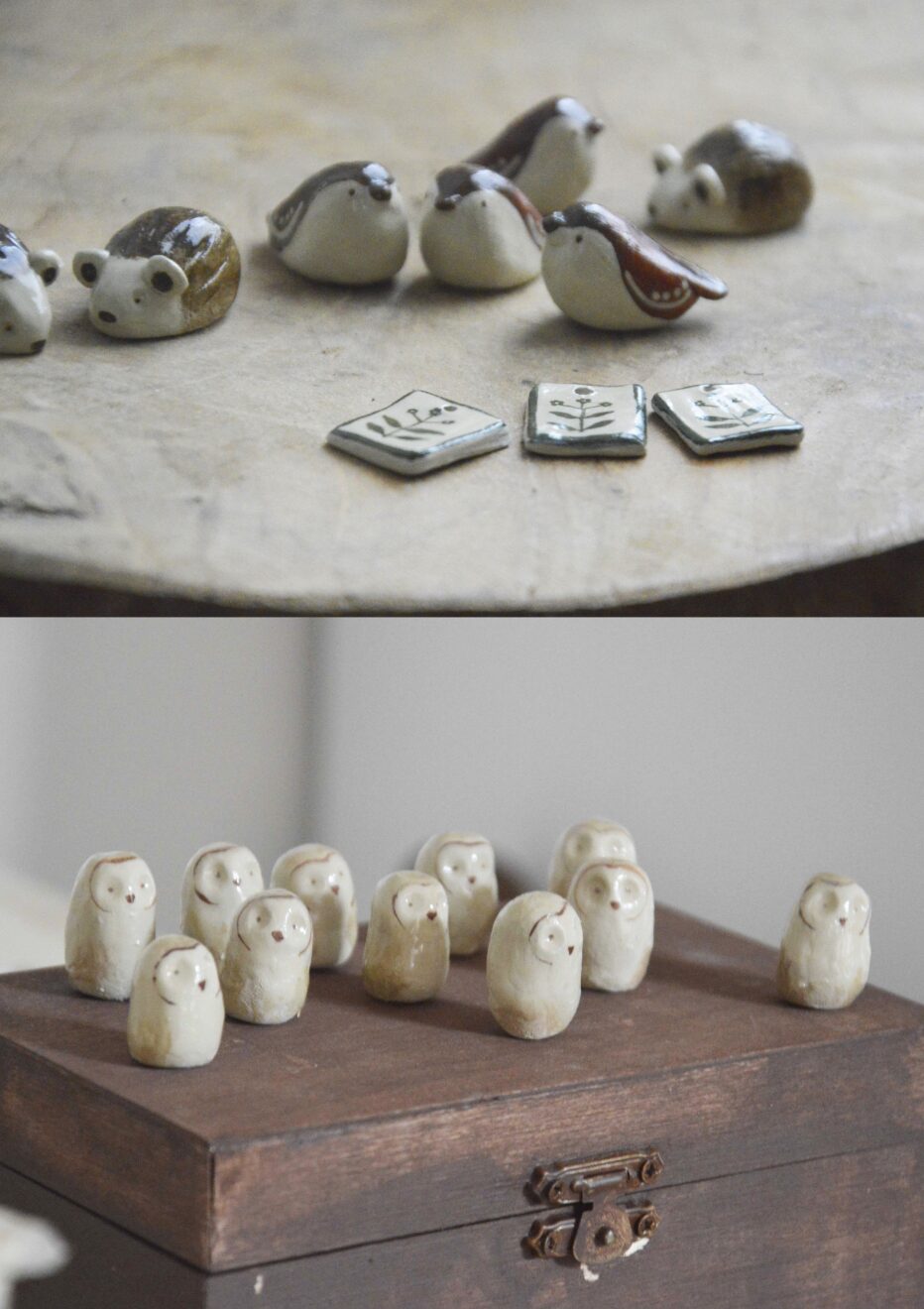
Chiara: At the moment, I work on Paper Poem part-time, but I truly hope to be able to dedicate myself to it full-time very soon. Nearly every single part of the process is done by me — from the concept design to cutting the wooden strips, from carving the stamps to making the stickers, from shaping the little clay animals to trimming the postcards. On top of that, I also manage the shop, the shipping, and all the communications.
Sometimes, it’s hard to find the mental space to fully dive into new designs, especially when there are orders that need to be finished. My mind is constantly active, and everything is planned out to the smallest detail. When something unexpected happens, like the car breaking down, the post office being closed, or an issue with printing — it all falls on me, and I don’t always have someone who can help right away.
It can often be a real challenge, but I’m lucky to have a wonderful partner who helps me whenever he can. And the kind messages I receive from the people who get my packages—those are truly some of the greatest joys I’ve ever experienced. The community around Paper Poem is so warm, supportive, and full of love that even in the most stressful moments, I know deep down it’s all worth it. I know this might feel a bit off-topic, but I truly wanted to say it.
My biggest dream is for Paper Poem to become a full-time job—something I can live off of while continuing to build this little magical world. It would be like stepping fully into my dream, and living inside of it.
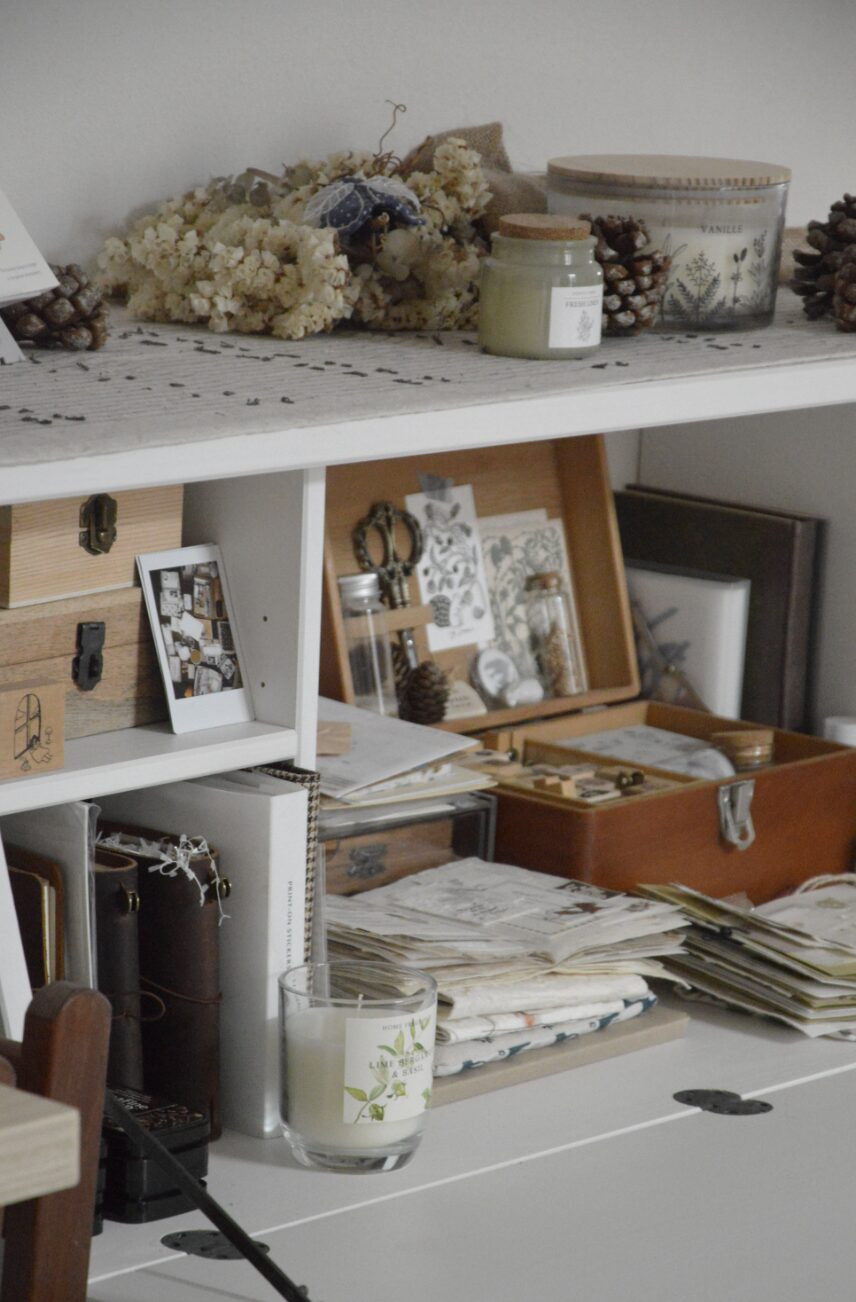
Hanny: What’s a typical day in your life look like?
Chiara: I wake up at 5:45 in the morning to have breakfast with my boyfriend. With a cup of tea always in hand, I tidy up the house a little and, if I have a lot of orders, I get to work on those right away. Otherwise, I read a few pages of whatever book I’m currently into.
From 8 a.m. until lunchtime, I work in the administration of the museums in my city. After eating, I take a short walk to relax, and then I focus on Paper Poem until dinner. In the evening, if I have artistic projects or exhibitions coming up, I work on those; otherwise, I read, take another walk, or watch a movie.
Before going to bed, if I still have a bit of energy, I light a candle, make an herbal tea, and write a few lines in my notebook. I usually go to sleep around 10 p.m.
Hanny: What are the steps when you’re designing a product? What makes you think, oh, I’ll make a stamp from this design and paper stuff from that design… how do you think about your collection or curate your seasonal stationery box?
Chiara: I think in seasons. As I mentioned earlier, my work is deeply inspired by nature. When I start envisioning a new collection, I think about the time of year I’d like to release it. I write down everything in my work journal — the type and quantity of each design — and then I go for a walk with my camera: an old Nikon 3200 I’ve carried with me for over eleven years.
That’s when the observation phase begins. When I notice the shape of a leaf, the texture of a surface, or a particular shade — maybe a beautiful olive green — that feels right for what I’m working on, I take a photo. Back home, I select the images I need and begin to refine them. That’s where the creative process really starts: I pull color palettes, animal shapes, and lately even tiny fairies inspired by the outlines of flowers. Once I’ve chosen most of the elements I want to work with, I organize them based on how they would look on a stamp, sticker, or ceramic piece.
Plants, for example, often have lines that work beautifully on paper — like creating a natural background where stamps and stickers can come to life. The stamps are usually inspired by floral elements or small creatures, and I see them as characters or natural features that can be used to build one’s own paper landscapes. I always try to keep my designs simple so that everyone can use them in different ways, creating as many variations as possible with a single motif.
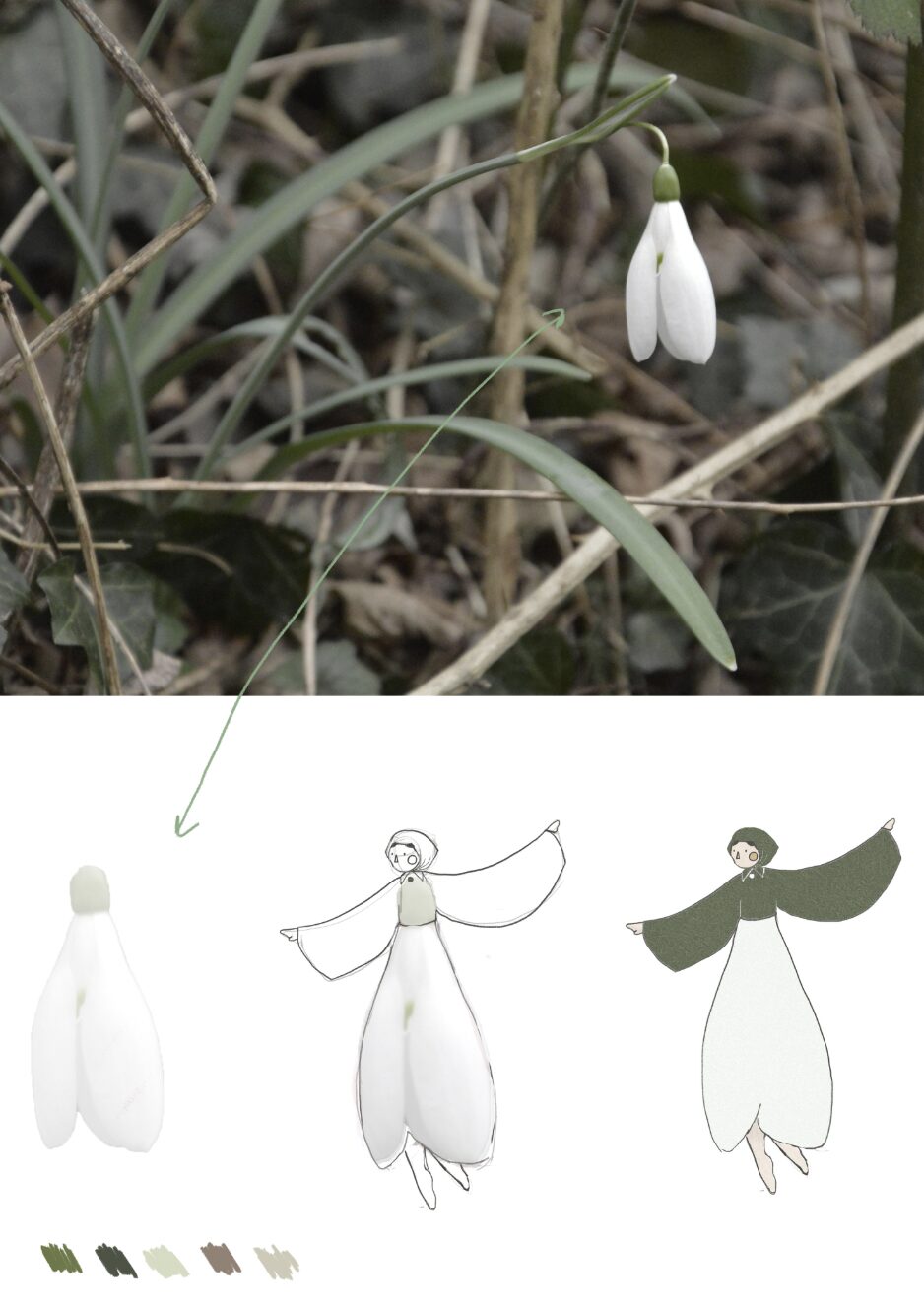
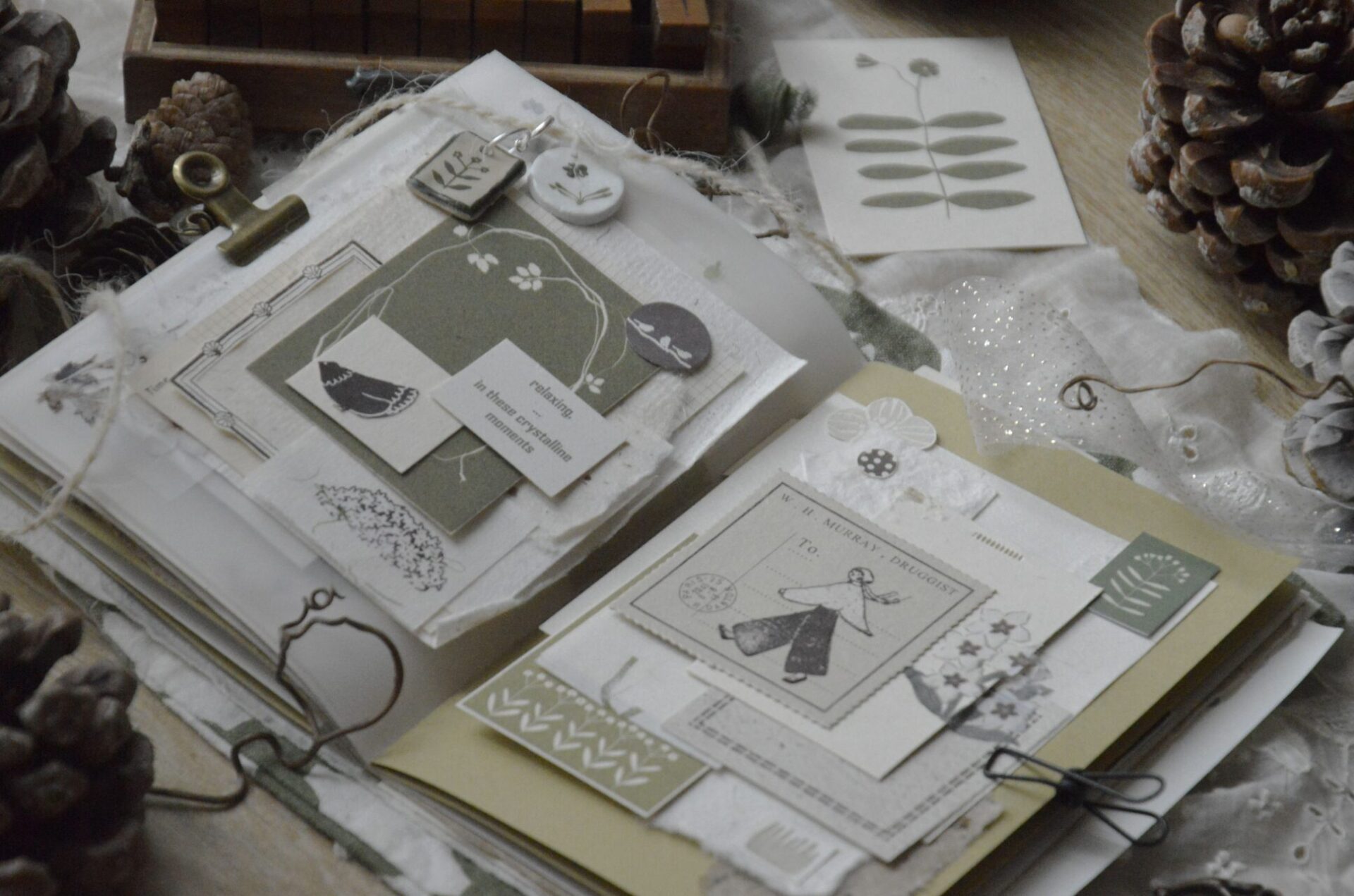
Seasonal stationery boxes are where all these thoughts come together. I always start by selecting handmade rice or fiber-based papers, which set the color tone of the box. Then I choose a seasonal animal guide and a fairy character, which I later carve onto the box. The small elements — like charms, stamps, or decorative papers — are added according to the feeling I want the collection to express.
The creative process is always very slow. From cutting the paper to carving the stamps, everything is handmade by me, and that takes a lot of time and care. When all the pieces are finally ready, I place them side by side and look at how they come together. That’s how my collections are born: little elements, designed to form a greater visual harmony.
We hope you are inspired and intrigued to dive deeper into Chiara’s world and to hear her creative process!
Enjoy your spring/summer time, and maybe next time you walk in Nature, you can also see shapes and images in the leaves, flowers, or rocks… like Chiara! 😀
paperhugs, Hanny

This was so interesting to read. I enjoyed hearing all the details of Chiara’s life. She expressed herself so eloquently drawing me in to her creative world. I loved this interview.